
REAL ECONOMY BLOG | April 05, 2024
Authored by RSM US LLP
While it’s always good to identify risks to the economic outlook, too often market players mistake the condition of a few trees—there are always isolated problems—with the health of the forest.
The primary takeaway from the jobs report is American exceptionalism. The U.S. economy continues to outperform its major trading partners and economic peers.
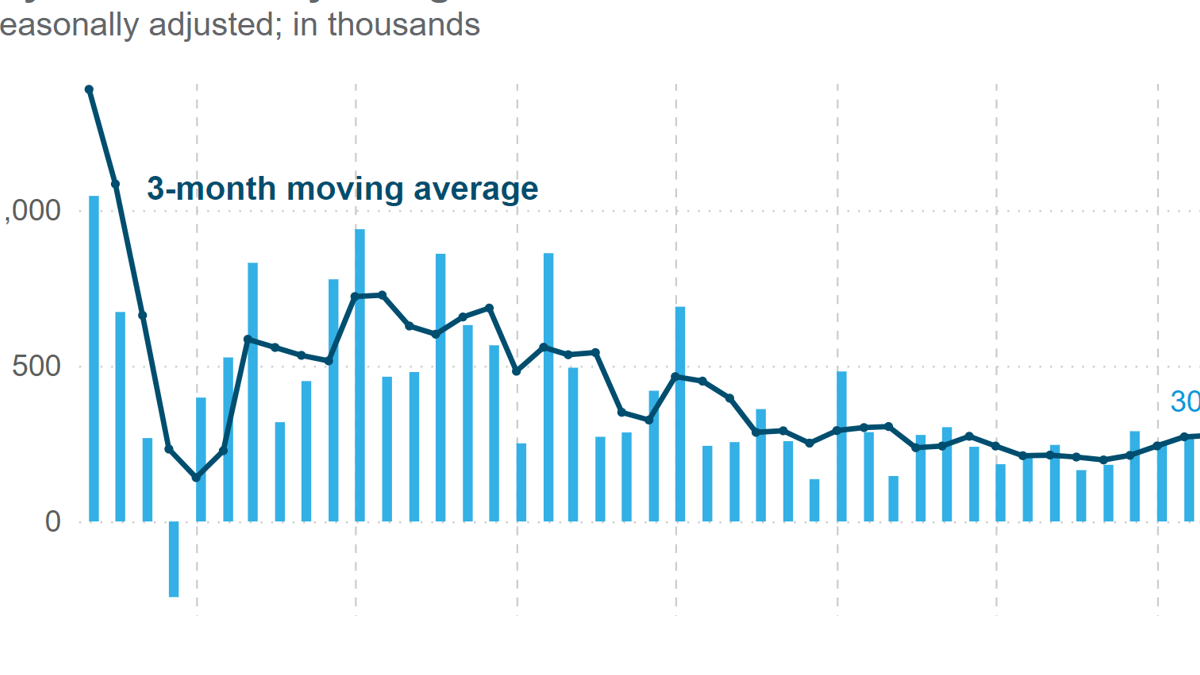
The March jobs report shows just how healthy the American labor market is, despite isolated criticisms. It is dynamic, resilient and growing. Employers added 303,000 jobs on the month as the unemployment rate fell to 3.8%, according to the Bureau of Labor Statistics on Friday. Overall unemployment has stayed below 4% for more than two years.
The labor force participation rate for prime-age workers 25 to 54 years old stands at 89.25% for men and 77.7% for women, consistent with pre-pandemic levels.
In addition, revisions to the January and February estimates resulted in a net gain of 22,000 jobs for both months combined. Growth in average hourly earnings slowed to 4.1% on a year-ago basis as the monthly figure rose by 0.3%.

The policy implication linked to the March payroll estimate is that the economy has reached full employment—the maximum level of employment consistent without causing an increase in inflation—and that a virtuous cycle that bolsters productivity and dampens inflation is now possible.
The Federal Reserve is now well positioned to reduce a restrictive policy rate consistent with the central bank’s forecast of three rate cuts this year.
It is critical that policymakers recognize and consider the increase in labor supply through the immigration channel and rising productivity when setting policy to avoid an unnecessary slowdown and increase in unemployment.
The data
Following three straight declines, the household survey indicated an increase in employment of 498,000 jobs, and the overall labor force increased by 469,000 in March.
That increase should temporarily placate the nattering nabobs of negativism who refuse to acknowledge a robust economy and domestic labor market.
Once one looks underneath the top-line number, one finds that roughly 73% of job gains were clustered in higher-paying industries. For example, jobs in the industries of goods production and construction increased by 42,000 and 39,000 on the month, respectively.

Trade and transport jobs increased by 27,000, retail trade by 18,000, professional business service employment by 7,000, and private education and health workers by 88,000.
Leisure and hospitality jobs increased by 49,000 while government jobs advanced by 71,000. Manufacturing and information industries had no net change.
Total private hours worked increased by 0.3% while overtime hours remained flat at 2.9. Overall labor force participation increased to 62.7% from 62.5% in February, and the employment-to-population ratio increased to 60.3% from 60.1% previously.
The median duration of unemployment stood at 9.5 weeks in March, which suggests that if workers lose a job, they typically find one within two to three months.
The takeaway
The primary takeaway from the jobs report is American exceptionalism. The U.S. economy continues to outperform its major trading partners and economic peers.
A dynamic labor market offering strong wage gains that exceed the inflation rate is attracting more people into the labor force, and that is bolstering productivity.
Over the past three months, job gains have averaged 276,000; over the past six months, that figure is 244,000. At the same time, wage growth has moved back toward sustainable levels, with overall unemployment remaining below 4% for the past 27 months.
Employment data for some time now has been consistent with what we refer to as a 3-2 condition, when unemployment rate stays in the 3% range, below 4%, and inflation is in the 2% range.
Improved productivity, healthy immigration and an appropriate policy mix from the Federal Reserve can create the conditions for strong growth, price stability and maximum sustainable employment.
This article was written by Joseph Brusuelas and originally appeared on 2024-04-05. Reprinted with permission from RSM US LLP.
© 2024 RSM US LLP. All rights reserved. https://realeconomy.rsmus.com/u-s-jobs-report-american-exceptionalism-amid-dynamic-growth/
RSM US LLP is a limited liability partnership and the U.S. member firm of RSM International, a global network of independent assurance, tax and consulting firms. The member firms of RSM International collaborate to provide services to global clients, but are separate and distinct legal entities that cannot obligate each other. Each member firm is responsible only for its own acts and omissions, and not those of any other party. Visit rsmus.com/about for more information regarding RSM US LLP and RSM International.

The FMF&E team is eager to learn about you and your business. We are a Central New York based certified public accounting firm serving nationwide clients since 1980. Our experienced and dedicated team provides audit, accounting, tax and consulting services to businesses throughout the United States. Our clients include many energy companies, financial institutions, construction and real estate developers, manufacturers, professional services, and wholesalers and distributors.
FMF&E is a team of over 85 highly skilled and motivated professionals. Our team members possess additional highly valued industry certifications such as Certified Valuation Analyst, Certified Fraud Examiner, Certified Credit Union Internal Auditor, NAFCU Certified Compliance Officer, and more. Our growth has come from applying a strong results-oriented approach to servicing our clients.
For more information on how FMF&E can assist you, please email info@fmfecpa.com.